

How to Identify High Quality Tea by Sight, Scent, and Taste
Last Updated: November 1, 2026
Quick Summary
You can identify high quality tea by checking the dry leaf first: whole pieces, even color, and a clean scent. Whole leaves hold their oils and release flavor slowly, so the cup tastes fuller and lasts through more steepings. If the dry leaf looks like dust and smells like nothing, the cup will taste like nothing too.
- Judge tea in under a minute using three senses: sight, smell, and taste.
- Start a loose-leaf selection with one green, one black, and one herbal tea.
- Ask the seller a specific process question to separate a serious seller from a reseller.
- Rub a pinch of tea powder between your fingers: pure powder feels slightly oily, filler feels dry and gritty.
- Store tea in a sealed, opaque container away from light, heat, moisture, spices, and coffee.
Table of Contents
- How to Tell If Tea Is Good Quality Before You Brew It
- Loose-Leaf Tea Buyer's Guide: What a Good Selection Looks Like
- How to Judge Tea Quality Online Without Smelling the Tin
- Signs of Adulterated Tea Powder and How to Spot Them
- A Repeatable Side-by-Side Tasting Method for High Quality Tea
- How Quality Cues Change by Tea Type and Processing Style
- Storage, Harvest Date, and Freshness Over Time
- Build Your First Loose-Leaf Selection at Elegance by LadyKath
- Frequently Asked Questions
How to Tell If Tea Is Good Quality Before You Brew It
You can tell a lot about tea before the water ever hits the leaves.
This guide walks you through the checks to make when assessing a tea. Identifying high quality tea starts with three senses: sight, smell, and taste.
Here's exactly what to look for, in order, so you can judge a tea in under a minute.
Read the Whole Leaves, Not the Dust at the Bottom
Whole leaves are the first sign of good tea. They hold their oils and release flavor slowly, so the cup tastes fuller and lasts through more steepings.
Broken leaves and dust release fast and fade fast. A bag full of crumbs usually means machine harvesting and rough handling.
Look for:
- Large, intact pieces with a clear shape
- Leaves of similar size, so they brew evenly
- Very little powder settled at the bottom of the bag
Color, Luster, and the Artificial Sheen to Avoid
Natural color varies. Green tea should look green to olive, black tea a deep brown-black, oolong somewhere between.
What you don't want is a flat, painted-on look, which can signal dyes or glazing. Muted luster is fine; a plastic-like shine is not.
Watch out: bright, uniform color across every leaf often means the tea was blended for looks, not flavor.
Loose-Leaf Tea Buyer's Guide: What a Good Selection Looks Like
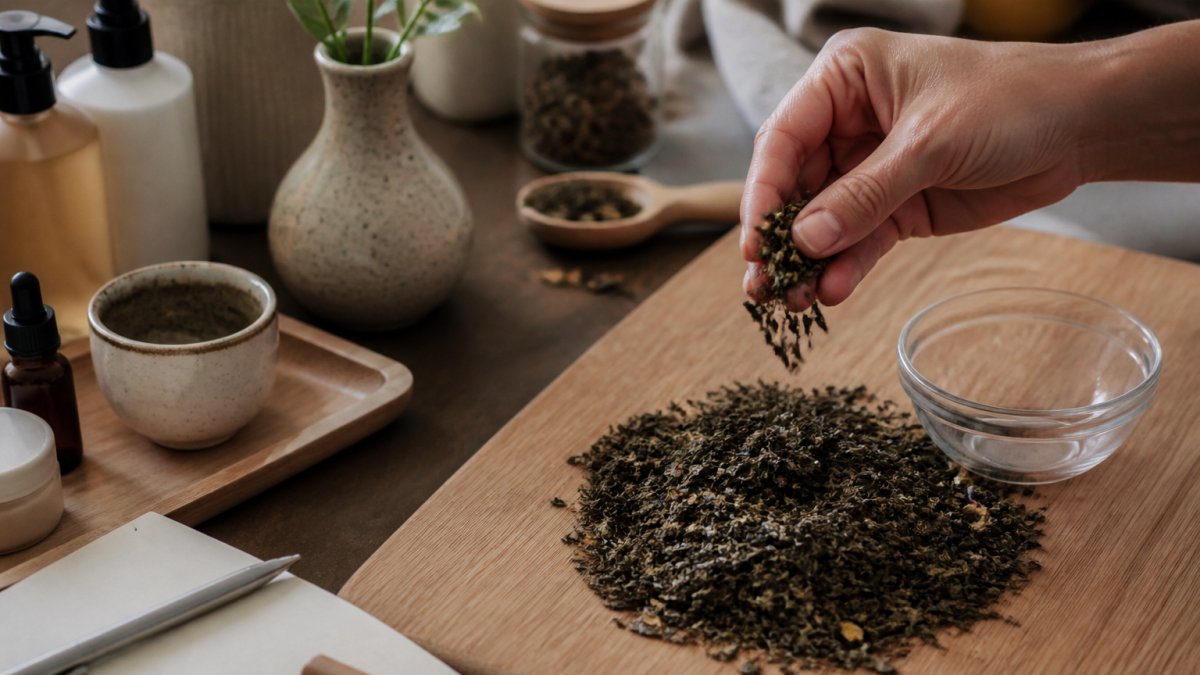
A good loose-leaf selection is small and focused. You want a handful of teas you'll actually drink, not twenty you'll forget in the cupboard.
Start with one green, one black, and one herbal tea, then add an oolong once you know what you like. Buy small quantities so nothing goes stale.
When you shop, check the product description for three things:
- Leaf grade or picking standard
- Harvest season and origin
- Whether the leaves are whole or broken
How to Judge Tea Quality Online Without Smelling the Tin
Online buying removes your nose from the equation, so replace it with a paper trail. Photos and reviews are a start, but they don't tell you whether the tea is what the seller says it is. The stronger approach is to audit provenance, certification claims, and defect language before you spend money.
Audit the provenance, not just the photo
A close-up photo of whole leaves is useful, but it's also the easiest thing to stage. Provenance details are harder to fake consistently. Look for four specifics:
- Origin: a region or garden name, not just a country. "Uji" or "Darjeeling" tells you more than "Japan" or "India."
- Cultivar or variety: named cultivars (for example, Yabukita for green tea or assamica for black) signal a seller who knows the product.
- Harvest date or season: "first flush," "spring 2026," or a specific month. A best-by date alone is not a harvest date.
A listing that gives all four is doing more work than most; one that gives none is asking you to trust a marketing adjective.
Read certification claims carefully
Certification claims are common online and easy to misread. In the United States, the USDA Organic seal is the main regulated claim for organic production, indicating the product meets National Organic Program standards for growing and handling.
Other claims, "beyond organic," "naturally grown," "regenerative", are not equivalent to the USDA seal and may not be independently verified.
Fair trade and other social certifications verify supply-chain practices, not cup quality; treat them as separate from a quality judgment.
Interpret review language as defect signals
Reviews are noisy, but certain words are reliable warning signs. Search the reviews for:
- "Stale," "flat," "papery," "dusty", freshness or storage problems
- "Bitter," "harsh," "drying", processing or brewing defects
- "Musty," "moldy," "basement", storage or aging problems
A single negative review proves little. A pattern of the same defect word across several reviews is a signal worth heeding.
Ask the seller a process question
The fastest way to separate a serious seller from a reseller is to ask a specific question: What was the oxidation level on this oolong? When was this green tea harvested? How was it stored?
If you want a deeper walkthrough of buying organic loose leaf online, our guide on Is It Worth Buying Organic Loose Leaf Tea Online? covers the questions to ask before you order.
Signs of Adulterated Tea Powder and How to Spot Them
Adulterated tea powder is ground tea stretched with fillers, dyes, or older leaf dust. It's most common in matcha-style powders and cheap blends.
Real tea powder smells like the tea it came from. If the tin smells sweet, grassy, or like nothing at all, be suspicious. A quick check: rub a pinch between your fingers.
A Repeatable Side-by-Side Tasting Method for High Quality Tea
Tasting two teas side by side is one way to learn how to tell if tea is good quality; comparing them can reveal differences a single cup may hide.
Use the same amount of leaf, the same water temperature, and the same steep time for both. Then compare.
| Step | What to Do | What to Note |
|---|---|---|
| 1. Set up | Two cups, same leaf weight, same water | Keep everything equal |
| 2. Smell dry leaf | Breathe in each sample | Fresh vs. stale aroma |
| 3. Steep | Same time and temperature | Watch liquor color |
| 4. Taste | Sip, hold, swallow | Flavor, sweetness, body |
| 5. Finish | Note the aftertaste | Astringency and bitterness |
A good tea tastes complex and clean. Bitterness that lingers past the swallow is a defect, not a feature.
How Quality Cues Change by Tea Type and Processing Style
A single checklist will mislead you, because the same leaf characteristic can signal quality in one tea and defect in another. What counts as good depends on how the leaf was withered, rolled, oxidized, fired, or aged.
Green tea: freshness is the whole game
Green tea is minimally oxidized, so its quality is tied to how recently it was harvested and how gently it was heated.
The aroma should be fresh and grassy, sometimes chestnut-like or marine. A hay-like or papery smell is a staleness cue. In the cup, expect a light body and a clean finish.
Processing matters here more than in any other type.
Black tea: even oxidation and intact structure
Black tea is fully oxidized, so the leaf color should be a deep brown-black with a consistent tone.
Whole, twisty leaves that hold their shape are a good sign. Broken pieces aren't automatically bad, but a bag dominated by crumbs and dust will brew thin and bitter.
In the cup, black tea should have body and a clean finish. Some astringency is expected, but it should fade.
Oolong: the shape tells you about the process
Oolong sits between green and black, and its quality cues are the most process-dependent. Ball-rolled oolongs should show tight, unbroken nuggets; strip-style oolongs should show long, intact twisted leaves.
Color ranges widely, from bright green for lightly oxidized styles to amber and dark brown for heavily oxidized or roasted styles. The key is consistency within the lot and a natural luster rather than a painted shine.
White tea: whole buds and gentle handling
White tea is the least processed, so visible handling damage shows up fast. Look for whole buds and leaves with visible silver-white down (trichomes) on the buds.
Color should be muted, silvery green, gray-green, or brownish depending on the style. Bright, uniform white is often a marketing look rather than a quality signal. The aroma is subtle by nature; a musty or damp smell is a storage defect.
Aged and fermented teas: maturity, not freshness
Aged teas such as pu-erh and aged oolongs are judged differently. Freshness is not the goal; clean storage and steady aging are. Look for intact leaves, even color, and no signs of mold or dampness.
Buyers new to aged tea often mistake strong earthy aromas for quality. The better test is whether the aroma is clean and layered rather than flat and moldy, and whether the cup is smooth rather than muddy.
Herbal blends: ingredients, not leaf grade
Herbal teas have no leaf grade to check, so judge them by what you can see. Whole flowers, whole herbs, and recognizable fruit pieces are a good sign. A blend that is mostly dust and stems is mostly filler. Color should look natural to the ingredient, not uniformly bright.
The through-line is simple: quality cues follow processing. Once you know how a tea was made, you know what to look for.
Storage, Harvest Date, and Freshness Over Time
Freshness is the quiet factor most buyers ignore. Tea doesn't spoil quickly, but it does go flat.
Check the harvest date when you can. Spring-harvest green tea tastes best within months, not years. Black and oolong teas hold longer.
Buy small quantities and refill often. That single habit does more for quality than any storage trick.
Build Your First Loose-Leaf Selection at Elegance by LadyKath
The best way to learn how to identify high quality tea is to taste good tea and compare it. Reading helps. Tasting teaches.
Elegance by LadyKath: Beans & Botanicals offers a curated selection of organic teas. Start with a small set, taste side by side, and build from there.
Visit the Elegance by LadyKath: Beans & Botanicals website to explore the current tea selection.
Frequently Asked Questions
What should you look for when buying high-quality tea?
Start with the dry leaf: whole, unbroken leaves of consistent size and shape, a natural (not painted-on) color, and a clean, fresh aroma with no mustiness. Check the packaging for a harvest or production date and a named origin. Then brew a small sample and judge the liquor color, flavor complexity, and how much astringency builds as it cools. High quality tea usually gives you several good infusions from the same leaves, while flat or stale leaf fades after one steep.
Does loose-leaf tea have better quality than tea bags?
Often, yes, but the bag is not the problem, the leaf inside it is. Most standard tea bags hold fannings and dust, which release color and tannin fast but little aroma. Loose-leaf selections usually keep whole leaves, so you can see leaf size, shape, and consistency before buying, which is the first quality cue. Some premium tea bags now use whole leaf, so read the product description and look for leaf grade rather than assuming the format decides quality.
How can you identify adulteration in tea powder?
Look at color, texture, and smell together. Adulterated tea powder often shows an unnaturally bright or uniform color, feels gritty or chalky between your fingers, and clumps when a drop of water is added. The aroma may be flat, dusty, or sharply chemical rather than fresh and natural. Brew a small amount: real tea powder settles into a clear liquor with a layered flavor profile, while adulterated powder can turn cloudy, taste bitter or metallic, and leave sediment. Buy from sellers who name origin and processing.
How do you judge tea quality online without seeing the leaves?
Use the listing as evidence. A trustworthy tea seller names origin, harvest date, leaf grade, and processing style, and shows close-up photos of the dry leaf rather than a styled cup. Read the product description for specifics like whole leaves, organic certification, and steeping guidance instead of vague words like premium. Order small quantities first, taste side by side, and only then commit to larger amounts. If a listing gives no harvest date and no leaf detail, treat the quality claims as unproven.
