

How to Fix Dull Dry Skin With a Gentle Daily Routine
Last Updated: October 25, 2026
Quick Summary
To fix dull dry skin, repair your skin barrier with a short, gentle routine: cleanse once at night with a fragrance-free cleanser, apply a humectant to damp skin, seal with an emollient cream, and add an occlusive on very dry patches. Skip harsh scrubs and acids until the barrier is stable, then exfoliate once a week at most.
- Shorten showers to 5-10 minutes and use warm, not hot, water.
- Apply moisturizer within 60 seconds of patting skin dry.
- Layer humectants on damp skin, then emollients, then occlusives at night.
- Wait two to three weeks of gentle care before adding any exfoliant.
- See a dermatologist if dryness does not improve after four to six weeks.
Table of Contents
- Why Skin Looks Dull and Dry at the Same Time
- How to Rehydrate Dry Skin Without Overwashing
- A Skincare Routine for Dry Skin That Builds Radiance
- Best Ingredients for Dry Skin That Soothe and Protect
- Gentle Exfoliation for Dry Skin: How Often and How
- Everyday Habits That Keep Skin From Turning Dull
- When Dry, Dull Skin Needs a Dermatologist
- Building Your Botanical Skincare Ritual
- Frequently Asked Questions
Why Skin Looks Dull and Dry at the Same Time
Dull dry skin usually has one root cause: a weakened skin barrier.
Two things happen when the skin barrier breaks down:
- Water escapes faster. Skin feels tight, flaky, or rough to the touch.
- Dead cells pile up. Light scatters instead of bouncing back, so skin looks gray or flat.
Most people treat dullness with scrubs and acids, then wonder why skin feels worse.
The American Academy of Dermatology's guidance on dry skin makes the same point: gentle care and consistent moisturizing beat aggressive treatment.
Dry Skin vs. Dehydrated Skin: What's the Difference?
Dry skin is a skin type. It lacks oil, and it stays dry year-round. Dehydrated skin is a temporary condition.
| Sign | Dry Skin | Dehydrated Skin |
|---|---|---|
| Feel | Rough, flaky, tight | Tight but sometimes oily |
| Cause | Low oil production | Water loss, weather, diet, hot showers |
| Timing | Constant | Comes and goes |
| Fix | Creams and ointments | Hydration plus barrier repair |
Dry skin needs lipids to seal in moisture. Dehydrated skin needs water-binding ingredients like hyaluronic acid, then a cream on top to lock it in.
Many people have both at once, so a combined routine works best.
How to Rehydrate Dry Skin Without Overwashing
Rehydrating dry skin starts with washing less, not more. Two long, hot showers a day plus a foaming cleanser can strip the barrier faster than any moisturizer can repair it.
- Shorten showers to 5-10 minutes. Long exposure to water breaks down the lipids that hold moisture in.
- Turn the temperature down. Warm water cleans just as well as hot water. Hot water pulls oil from skin.
- Use a gentle cleanser. Look for fragrance-free formulas. Skip anything that foams heavily or leaves skin squeaky.
- Cleanse once at night. In the morning, rinse with lukewarm water. Your skin does not need a full wash after sleeping.
- Apply moisturizer within 60 seconds of patting dry. Damp skin absorbs cream far better than dry skin.
Shaving counts as washing too. Shave after a warm shower, use a shave cream without fragrance, and moisturize right after.
A Skincare Routine for Dry Skin That Builds Radiance
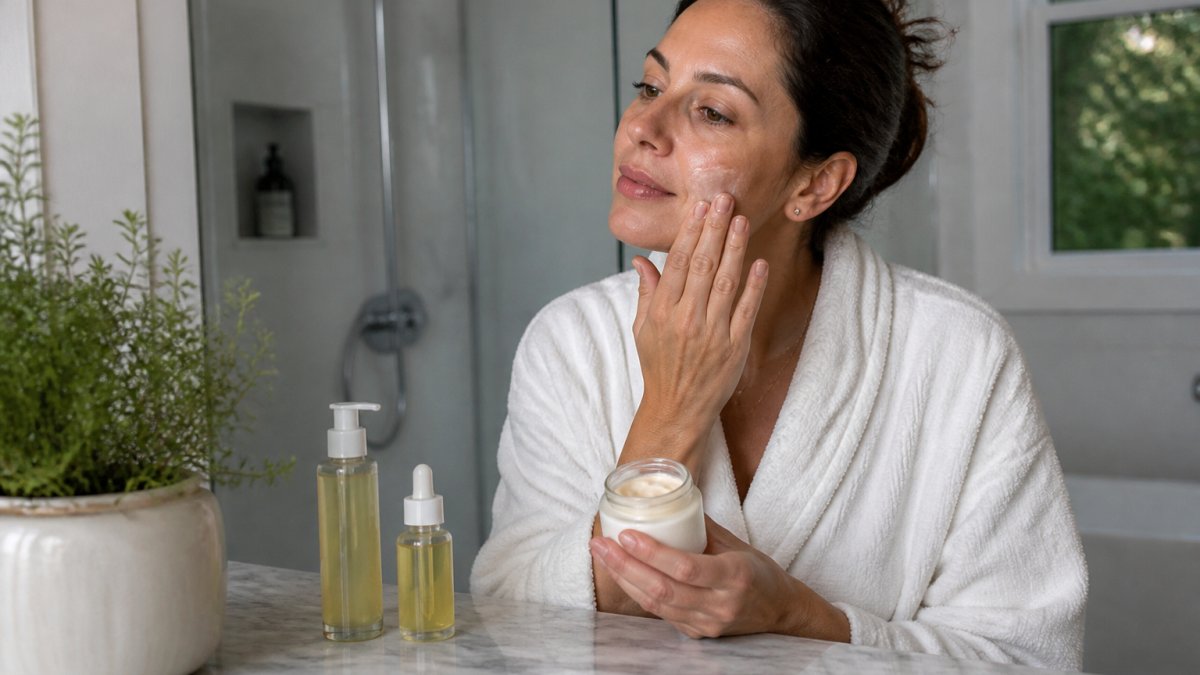
A skincare routine for dry skin works best when it is short: four steps morning and night. Radiance comes from consistency, not stacking products.
Morning Steps
- Rinse with lukewarm water. No cleanser needed unless you feel oily.
- Apply a hydrating serum. Hyaluronic acid works well on damp skin.
- Seal with a moisturizer. A cream, not a lotion, if skin is very dry.
- Finish with sun protection. The Skin Cancer Foundation's daily sunscreen guidance recommends broad-spectrum SPF every day, not just in summer.
Evening Steps
- Cleanse gently. Fragrance-free cleanser, lukewarm water, 30 seconds of contact.
- Treat if needed. A retinol or brightening serum, two to three nights a week to start.
- Apply a thicker cream or ointment.
- Add an occlusive layer on very dry patches. A thin layer of ointment on cheeks or around the nose helps.
That is the whole routine. No toners, no essences, no ten-step rituals. Simplicity is the point.
Best Ingredients for Dry Skin That Soothe and Protect
The best ingredients for dry skin fall into three groups: humectants that pull water into the upper layers, emollients that soften and fill the gaps between cells, and occlusives that seal water in. A routine using only one group underperforms, so know which ingredient does which job and how to layer them.
The three groups, and what each actually does
-
Humectants attract and hold water. Apply them to skin that is still damp, since they need water to bind.
- Hyaluronic acid: holds many times its weight in water. In low humidity it can pull moisture from deeper layers unless sealed with an occlusive.
- Glycerin: inexpensive, well tolerated, and one of the most studied humectants.
- Panthenol (provitamin B5): humectant and soothing agent; helpful on skin that stings.
-
Emollients soften rough texture and improve flexibility.
- Ceramides: rebuild the barrier's natural lipid structure, alongside cholesterol and fatty acids.
- Squalane: lightweight, plant-derived, and unlikely to clog pores.
- Fatty alcohols (cetyl, stearyl): not drying alcohols; they give creams their body.
-
Occlusives sit on the surface and slow water loss.
- Shea butter and plant oils: rich and effective, though some with sensitive skin react to certain botanical oils.
- Petrolatum: one of the most effective occlusives available, though texture is heavy.
- Dimethicone: a lightweight silicone that forms a breathable film; common in drugstore moisturizers.
How to layer them in order
The sequence matters more than the brand. A workable order:
- Cleanse gently and leave skin slightly damp.
- Apply a humectant serum or essence to damp skin.
- Apply an emollient-rich moisturizer to soften and support the barrier.
- Seal very dry patches with a thin occlusive layer at night.
Match the ingredient to the concern
- Dry skin (low oil): lean on emollients and occlusives. Ceramides, squalane, shea butter, and petrolatum do the heavy lifting.
- Dehydrated skin (low water): lean on humectants first, then seal. Hyaluronic acid and glycerin on damp skin, followed by a cream.
- Dullness on top of dryness: add niacinamide, which supports the barrier and improves tone over time, and consider a gentle brightening agent only after the barrier is stable.
What to skip or use with care
- Fragrance and essential oils in leave-on products, especially on sensitive or reactive skin.
- Alcohol-based toners and astringents, which strip oil and can worsen tightness.
- High-strength acids used daily. They belong in a controlled exfoliation step, not in a daily leave-on layer.
Gentle Exfoliation for Dry Skin: How Often and How
Exfoliation is where dull-skin advice and dry-skin advice collide. The resolution is sequencing: repair the barrier first, then exfoliate at low frequency and strength, and stop at the first sign of irritation.
Why exfoliation helps dullness, and why it backfires on dry skin
Dullness partly comes from dead cells piling up unevenly and scattering light. Exfoliation smooths the surface, but on dry skin the compromised barrier means aggressive exfoliation strips lipids, increasing water loss and leaving skin duller and tighter. Remove just enough buildup to restore smoothness without weakening the barrier further.
Chemical versus physical: what to choose
- Chemical exfoliants dissolve the bonds between dead cells. For dry skin, lactic acid and mandelic acid are gentler, larger-molecule acids that act more slowly than glycolic acid. Salicylic acid is oil-soluble and suited to oily or acne-prone skin, but it can dry out very dry skin.
- Physical exfoliants rely on friction. Soft washcloths and gentle enzyme powders are lower-risk. Coarse scrubs with walnut shells, apricot pits, or large salt grains can cause micro-tears and should be avoided on dry or sensitive skin.
- Enzyme exfoliants (papain, bromelain) are a middle path: they digest dead cells and are usually well tolerated, though they can still irritate reactive skin.
A safe starting schedule
- Repair first. Spend two to three weeks on gentle cleansing and moisturizing before adding any exfoliant; wait longer if skin still stings or flakes.
- Start once a week, at night. Apply a low-strength lactic or mandelic acid serum to dry skin, avoiding the eyes and any broken skin.
- Moisturize immediately after with an emollient cream to offset barrier stress.
- Build to twice a week only if skin stays calm for two weeks straight. Do not exceed this unless a clinician advises otherwise.
- Pause during flares. Stop exfoliation if skin is cracked, bleeding, or irritated until it settles.
Stop signals and how to respond
- Stinging that lasts more than a minute: the strength or frequency is too high. Stop for a week, then restart lower.
- Redness, flaking, or tightness the next morning: you over-exfoliated. Pause, focus on barrier repair, and resume at half the frequency.
- Increased sensitivity to other products: the barrier is compromised. Drop all actives until it recovers.
The combined routine for dull, dry skin
The sequence that reconciles both concerns:
- Weeks 1-3: gentle cleanse, humectant, emollient cream, occlusive on dry patches. No exfoliation.
- Weeks 4-6: add one night of low-strength lactic or mandelic acid per week, followed by moisturizer.
- Weeks 7+: if skin is calm, add a second exfoliation night. Keep the rest of the routine unchanged so you can tell what is working.
Everyday Habits That Keep Skin From Turning Dull
Small daily habits shape skin more than any single product. The American Academy of Dermatology's skin care tips points to the same everyday basics: short showers, gentle products, and immediate moisturizing.
- Drink water through the day. Dehydration shows on skin first.
- Use a humidifier in winter. Dry indoor air pulls moisture from skin overnight.
- Wear soft, breathable fabrics. Wool and rough synthetics against the skin cause irritation.
When Dry, Dull Skin Needs a Dermatologist
Some cases need professional care. See a dermatologist if any of these apply:
- Dryness that does not improve after four to six weeks of gentle care
- Cracks, bleeding, or open sores
- Intense itching that disrupts sleep
A dermatologist can prescribe topicals, identify triggers, and rule out conditions that mimic simple dryness.
Building Your Botanical Skincare Ritual
Pair your evening skincare with a quiet ritual: a warm cup of our organic tea, a few minutes of stillness, and a routine you do not dread. The products nourish and hydrate.
If you are also restocking your morning brew, you can explore our fresh-roasted organic coffee while you are here.
Frequently Asked Questions
How long does it take to improve dull, dry skin?
Most people notice softer, less tight skin within one to two weeks of consistent cleansing and moisturizing. Visible radiance takes longer, around four to six weeks, since the skin barrier needs time to repair. Persistent dullness after two months is a good reason to see a dermatologist.
Should I exfoliate if my skin is dry and dull?
Yes, but gently. Exfoliation removes the dead cells that cause dullness, but harsh scrubs or daily acids damage the barrier and worsen dryness. Use a mild lactic acid or enzyme exfoliant once or twice a week, then moisturize while skin is still damp. If it stings or turns red, stop for a week.
What ingredients should I look for in a skincare routine for dry skin?
Look for humectants like hyaluronic acid and glycerin, emollients like shea butter and squalane, and occlusives like beeswax or dimethicone to seal moisture in. Niacinamide helps with dullness and barrier support. Choose fragrance-free formulas, avoid strong acids if sensitive, and patch test new products first.
How do I tell if my skin is dry or dehydrated?
Dry skin lacks oil and feels rough or flaky most of the time. Dehydrated skin lacks water and can feel tight even if it looks oily. A simple test: if moisturizer absorbs quickly but skin still feels tight, dehydration is likely the issue. Humectants like hyaluronic acid under a cream help dehydrated skin.
Dry, dull skin rarely needs a bigger routine. It needs a gentler one, done consistently. If you have sensitive skin and want products built for it, browse our sensitivity-focused skincare collection. Get started with Elegance by LadyKath: Beans & Botanicals and build a routine your skin can actually tolerate.
