

How to Create a Wellness Retreat at Home
Quick Summary
A wellness retreat at home is a planned reset: you set aside real time, set one clear intention, and shape a calm space away from screens and routine demands. Half-day, full-day and weekend formats all work, so you can choose the length that fits your life.
- Pick one clear intention before planning, such as sleeping better or feeling less scattered.
- Choose a half day (3-4 hours), full day (8-10 hours) or weekend (2-3 days) based on your schedule.
- Put the retreat on your calendar and tell the people you live with exactly when you'll be offline.
- Use a low-cost setup like a folded blanket, a candle, water, a notebook and quiet music or silence.
- Build your schedule around three anchors: a morning opening, a midday reset and an evening close.
Table of Contents
- Set Your Intention and Choose Your Retreat Length
- Block Out the Time and Tell Your Household
- Prepare a Calm Space Without Spending a Fortune
- Build an Hour-by-Hour Schedule
- Plan a Silent Retreat Stretch Without Distractions
- Run a Self-Guided Silent Retreat Day
- Plan Your Re-Entry and Book Your Next Reset
- Frequently Asked Questions
Set Your Intention and Choose Your Retreat Length
A wellness retreat at home is a planned reset. You set aside real time, shape a calm space, and step away from screens and routine demands.
Pick one clear intention before you plan anything else. "I want to sleep better and feel less scattered" gives you a standard to measure every choice against.
Then choose a length that fits your life. Shorter retreats work well for busy people, and longer ones give more room to slow down.
Plans for a Half Day, a Full Day or a Weekend
- Half day (3-4 hours): Best for busy professionals. Focus on one practice, like a slow walk and a journaling session.
- Full day (8-10 hours): Good for a deeper reset. Mix movement, meals, rest, and reflection.
- Weekend (2-3 days): Gives room for real rest. Plan for an unhurried start and a gentle re-entry on the last day.
Start small if you're new to this. A half day you finish feels better than a weekend you abandon by Saturday noon.
Block Out the Time and Tell Your Household
Put the retreat on your calendar like any other appointment. If it's not scheduled, it will get pushed aside.
Next, tell the people you live with. A simple note works: "I'm off screens and offline from 9 a.m. to 3 p.m.
Common mistake: treating the retreat as optional and then answering "just one quick message." Turn off notifications and set an auto-reply if needed.
Prepare a Calm Space Without Spending a Fortune
You don't need expensive décor to create a calm space. Clear one room or corner and remove visible clutter. Dim the overhead lights and use lamps or candles instead.
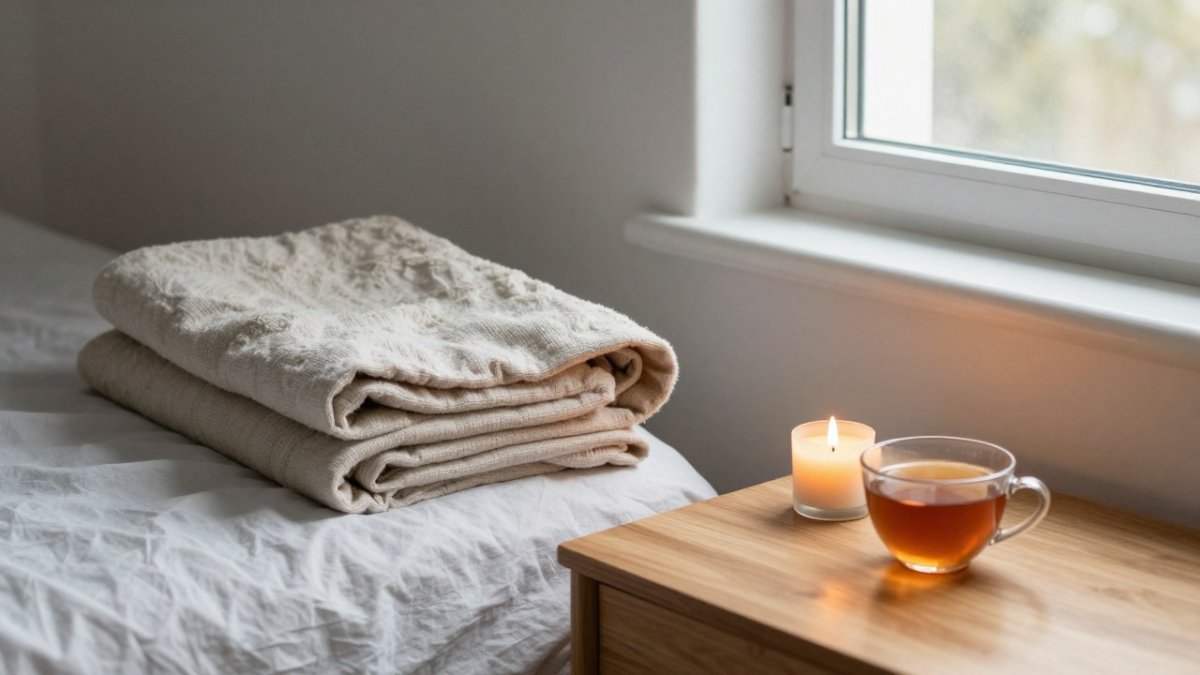
Here is a low-cost setup that works well:
- A folded blanket or cushion for sitting or lying down
- A candle or battery-operated tea light
- A glass of water and a simple snack
- A notebook and pen for reflection
Use what you already own. A bedsheet can become a cozy wrap, and a houseplant adds a fresh touch for free.
Build an Hour-by-Hour Schedule
A schedule is what separates a retreat from a lazy day that slips away. You do not need a minute-by-minute itinerary, but you do need a spine: a few anchor points that give the day shape and enough white space that it never feels like a work calendar.
Build your schedule around three anchors rather than a full grid: a morning opening, a midday reset, and an evening close. Everything between them is flexible. This structure works whether you have three hours or three days.
Half-Day Schedule (3-4 Hours)
- 0:00: Opening ritual, light a candle, state your intention, take five slow breaths.
- 0:15: Gentle movement, 15 minutes of stretching, a short yoga flow, or a slow walk.
- 0:45: Stillness, 10 minutes of breathing or a guided meditation.
- 1:00: Journaling, three prompts, 15 minutes.
Full-Day Schedule (8-10 Hours)
- 8:00 a.m.: Slow wake-up, a full glass of water, and five minutes of quiet breathing.
- 9:00 a.m.: Gentle stretching or a 20-minute walk outside.
- 10:30 a.m.: Journaling about your intention.
- 12:00 p.m.: A simple lunch, eaten slowly and without a screen.
Weekend Schedule (2-3 Days)
- Day 1: Arrival and decompression. Keep it light, a walk, a bath, an early night. Do not schedule deep reflection on day one; most people are still running on weekday momentum.
- Day 2: The fullest day. Movement, a silent stretch, outdoor time, and journaling. This is where the reset actually happens.
- Day 3: Gentle re-entry. A short practice, a closing reflection, and a realistic plan for the week ahead. End by mid-afternoon so the transition back is not abrupt.
Adapt for Energy, Mobility, and Sensory Needs
A schedule that assumes a full day of yoga and hiking will fail anyone with chronic illness, low mobility, or sensory sensitivity. Build in alternatives from the start:
- Low energy or chronic illness: Swap movement blocks for seated stretching, restorative poses with props, or simply lying down with eyes closed. Shorten every block by half and add a rest period after each activity. A 20-minute practice you finish beats a 60-minute one you abandon.
- Low mobility: Replace walks with seated breathwork, chair yoga, or a slow range-of-motion routine. Outdoor time can happen on a porch, by a window, or in a garden with a seat.
- Sensory sensitivity: Skip scented candles and loud music. Use unscented lighting, a weighted blanket, and silence or low-volume ambient sound. Keep the schedule quieter and shorter, with more buffer between activities.
When the Plan Goes Sideways
Watch out: the most common failure is treating the schedule as a test you can fail.
Keep two rules: never skip the opening and closing rituals, and always leave at least 30 minutes of unscheduled time between anchors. Unplanned time is not a gap in the retreat; it is part of it.
The article lays out how to shape a retreat day by length, so the timing for each format is easy to compare at a glance.
| Retreat length | Typical duration | Structure |
|---|---|---|
| Half day | 3-4 hours | Opening ritual, movement, stillness, journaling, snack, outdoor time, reflection |
| Full day | 8-10 hours | Wake-up, walk, journaling, lunch, protected rest, light movement, reflection |
| Weekend | 2-3 days | Day 1 decompression, Day 2 fullest day, Day 3 gentle re-entry |
Plan a Silent Retreat Stretch Without Distractions
A silent retreat stretch means a block of time with no talking, phones, or screens.
Start with one to two hours. Tell your household, put your phone in another room, and keep a notebook nearby for thoughts that pop up. Writing them down lets you let them go.
Watch out: many people reach for their phone during the first silent hour out of habit. Keep it out of reach and out of sight before you begin.
Run a Self-Guided Silent Retreat Day
A self-guided silent retreat day gives you structure without a teacher, and it is the format most people picture when they think of a retreat. It is also the one most likely to fall apart, because silence at home competes with doorbells, group chats, and the refrigerator. The fix is preparation: decide in advance what silence means for your day, tell the people around you exactly what you need, and set up the space so the default choice is stillness rather than a screen.
Prepare the Day Before
A silent day is won or lost the night before. Use this checklist:
- Choose your silence window. Four to six hours is realistic for a first attempt; a full day is an advanced move. Write the start and end times down.
- Tell your household in specific terms. "I am not speaking or checking my phone from 9 a.m. to 3 p.m. Saturday. Please handle lunch and knock only for emergencies" works better than "I'm doing a silent day."
- Set up a communication fallback. A sticky note on the door or a shared calendar block prevents the "just one quick question" interruption.
- Stage your supplies so you are not hunting for them mid-day: a notebook and pen, water, a simple snack, a cushion or blanket, and a candle or battery-operated tea light.
- Move your phone to another room and turn off notifications on any device you keep nearby. An auto-reply on email and messaging is a reasonable courtesy if you normally respond quickly.
A Simple Silent-Day Flow
- Opening ritual: Light a candle and state your intention out loud, the last words you will speak for the window.
- Gentle movement: 15 minutes of stretching or easy yoga, adapted to your energy and mobility.
- Breathwork: Sit quietly and breathe slowly for 5-10 minutes.
- Walk outdoors: 20-30 minutes in fresh air or sunlight, or seated time by a window if mobility is limited.
- Reflection: Write answers to three questions: What felt good? What felt hard? What do I want to carry forward?
- Closing ritual: Thank yourself for the time and blow out the candle.
Keep the day flexible. If you feel tired, rest instead of pushing through the list. Silence is the practice; the activities are just scaffolding.
Make It Work in a Shared Home
Living with children, a partner, roommates, or someone you care for changes the logistics but not the goal. A few patterns that work:
- Trade time. Ask a partner or friend to cover childcare or caregiving for a four-hour block, and offer the same in return on another day.
- Use a partial-silence compromise. If full silence is not realistic, define a quiet zone, one room, headphones on, no conversation, and treat it as the retreat space.
- Lower the bar for the day. A two-hour silent stretch during a child's nap or school hours still counts. Consistency matters more than duration.
- Plan a re-entry buffer. Give yourself 30 minutes after the silent window before resuming household conversation, so the transition is not jarring.
Track What Actually Restored You
A silent day is only useful if you learn something from it. At the close, rate three things on a simple one-to-five scale: your energy, your mental clarity, and your sense of calm.
Watch out: the first silent hour is when the urge to reach for your phone is strongest. Keep it out of reach and out of sight before you begin, and keep the notebook nearby for thoughts that pop up.
Plan Your Re-Entry and Book Your Next Reset
The end of a retreat matters as much as the start. Don't jump straight back into email and errands. Give yourself 30 minutes to transition.
Write down one or two habits you want to keep, such as a morning walk or a weekly screen-free evening. Then pick a date for your next reset. Scheduling the next one keeps the benefits going.
When you're ready to build your evening self-care ritual, explore the Elegance by LadyKath: Beans & Botanicals collection, which includes sensitivity-focused skincare products and fragrances made from 100% essential oils.
Frequently Asked Questions
How can I create my own wellness retreat at home?
Start by choosing one intention, such as rest, clarity or reconnecting with your body. Pick a date and block out dedicated time on your calendar. Clear a quiet space, turn off notifications and write a simple schedule that mixes gentle movement, meals, reading, journaling and time outdoors. Keep the plan flexible so it fits your energy on the day. Close the retreat with a short reflection on what you want to carry into the following week.
How long should a personal retreat day last?
Most people find that six to eight hours works well for a personal retreat day, though a half day or a single evening can also reset your routine. Shorter retreats suit busy schedules and caregiving responsibilities. A full day gives time for deeper rest, longer stretches of quiet and a relaxed meal. Choose the length that matches your available time and energy, then build the schedule around it rather than the other way around.
How do I do a silent retreat at home?
Tell the people you live with when your silent period begins and ends, and agree on how to handle emergencies. Silence means no talking, reading the news, scrolling or messaging. Keep meals simple and eat slowly. Use short walks, gentle stretching and sitting meditation to structure the time. If full silence feels too difficult, start with a few hours and extend it on future retreats. Write notes in a journal rather than speaking your thoughts aloud.
How can I create a wellness retreat at home on a budget?
Most of a home retreat costs very little. Use items you already own, such as blankets, candles, a bath and a notebook. Plan simple meals from groceries you already buy, and use free resources like a library book, a guided meditation recording or a walk in a local park. If you want a few extras, such as a new tea or a single skincare product, budget for them in advance. Pricing for specific products depends on quantity and delivery, so check the Elegance by LadyKath: Beans & Botanicals website for current prices.
